

Database-level isolation
Every company’s data is kept apart by the database itself. A request for another company’s data returns nothing.
Assetras treats security as a database responsibility, not something the interface has to remember to do.
Every company’s data is kept apart by the database itself. A request for another company’s data returns nothing.

Asset events and audit records are append-only. They cannot be edited or deleted through the product.

Uploaded files are stored privately and accessed through links that expire after 60 seconds.
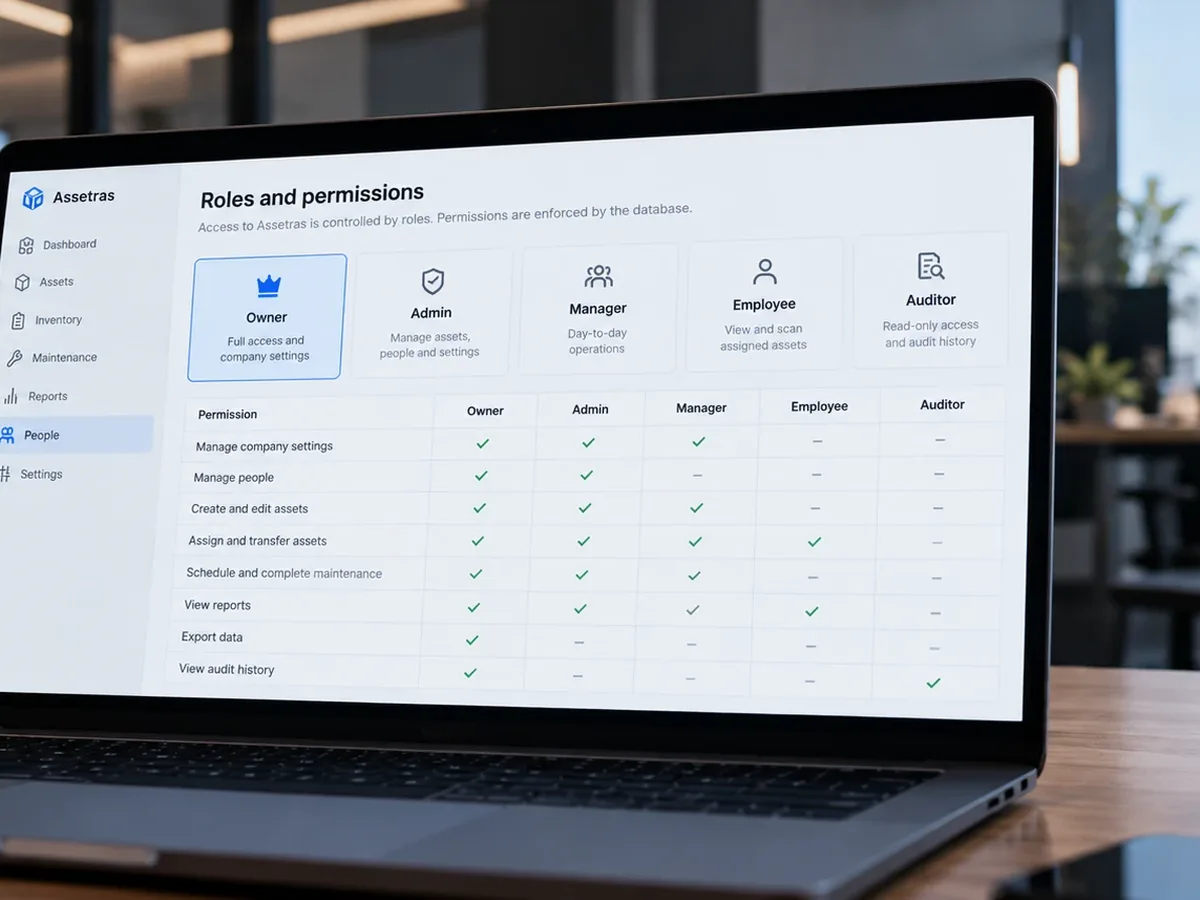
Owner, admin, manager, employee and auditor permissions are enforced by the database.

Your data and uploaded files are hosted in Ireland, and backups stay in the same region.

Every user can protect their account with an authenticator app and six-digit verification codes.
We deliberately test cross-company reads, writes, deletes, privilege escalation and signing in without the second factor. Every check has to fail.
No analytics and no tracking. The site loads nothing from other companies’ servers and limits where your browser is allowed to connect.
Database snapshots are taken every day and kept for seven days in Ireland. Your data can also be exported to CSV or PDF at any time.
What we promise is what the system enforces, and it is checked.
Access policies are reviewed as the product changes, and tenant isolation is covered by a test suite that has to pass. Security controls are verified rather than assumed.
What the system enforces today: each company’s data kept apart by the database, a history that cannot be rewritten, private files, permissions by role and boundaries that are tested. How each of those works is set out below.
In plain words, for anyone who wants to look a little closer.
All companies use the same secure database, but the database itself decides who may see what. Every request is checked against the company of the person who is signed in, and a request for another company’s information comes back empty.
That check lives in the database, underneath the app. It holds even if somebody tries to go around the screens.
We run a set of automated checks that sign in as one company and deliberately try to reach another: to read its data, change it, delete it, act above their role or skip the second sign-in step. Every attempt has to fail.
TENANT ISOLATION: all 96 checks passed
The checks are tested too. We break the protection on purpose and make sure they notice.
Everything that happens to an asset, who had it, when it moved and what changed, is recorded permanently, and so is every action in the activity log. New entries can be added. Nobody can edit or delete an old one through Assetras, not an admin and not an owner.
Five roles decide what each person can see and do: owner, admin, manager, employee and auditor. The role is checked by the database, not by the screen, so nobody can give themselves more rights from their browser.
Every user can add a second step to their sign-in: a six-digit code from an app on their phone. Once it is on, the code is required every time. If somebody loses their phone, an owner or an admin can reset it, and every reset is recorded.
Anyone standing next to a piece of equipment can scan its label, so the label opens nothing on its own. It leads to a page that asks you to sign in, and it shows the asset only to people from the company that owns it.
Each label carries a long random code rather than the asset number, so labels cannot be guessed.
Invoices, photos and other files you upload are private. Only signed-in people from your company can open them, through links that stop working after 60 seconds.
The site tells your browser to talk only to Assetras, not to let other websites show it inside their own pages, and to always use an encrypted connection. These are the standard protections against the common web attacks.
Signed out, the site uses no cookies and no tracking, which is why there is no cookie banner.
Your data and your files are kept in Ireland, inside the EU. A copy of the database is taken every day and kept for seven days, in the same region.
The daily copies cover the database. Uploaded files are stored separately and are not part of them, and you can export your records to CSV or PDF at any time.
What is stored, for how long, and who processes it is set out in the privacy policy and the data processing terms. Found something wrong on this page? Tell us and it gets corrected here.